


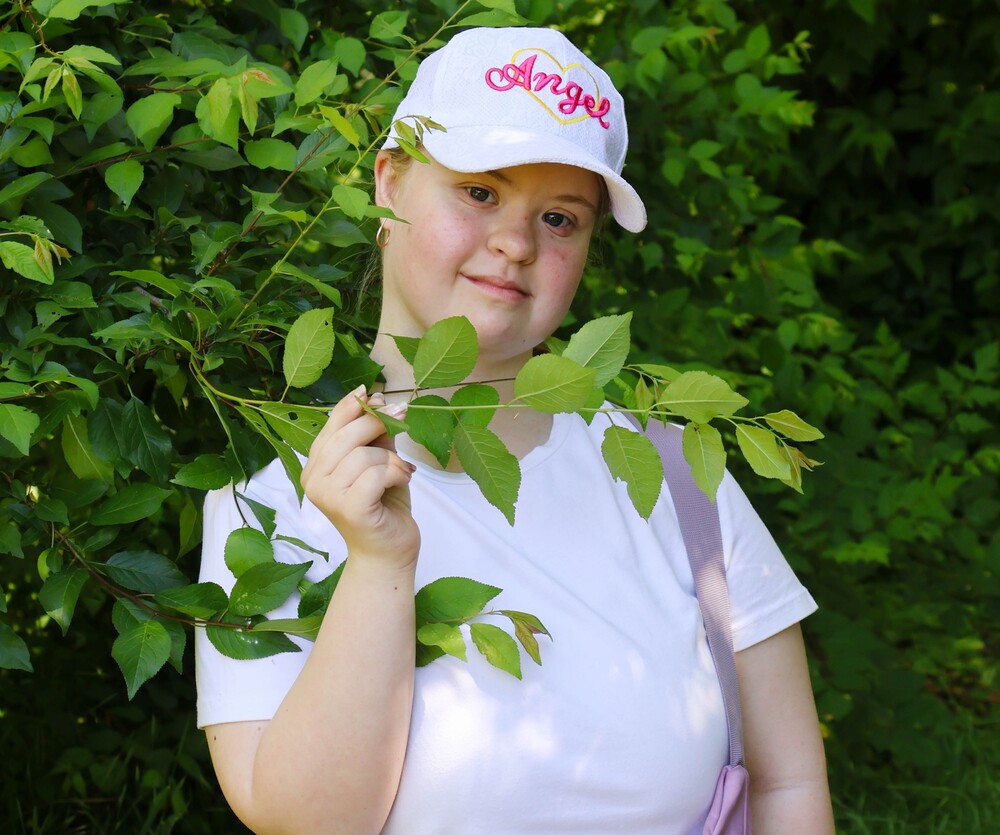
The winter holidays were approaching, and the specialists invited everyone to learn a poem for the upcoming celebration.
They soon noticed that Nastia found it difficult to memorize things. But things changed when she started learning Christmas songs. Day by day, she sang the lyrics more confidently, danced along and smiled. Eventually, she learned and sang her first song: “The old year is passing, the new one is coming. The new one is coming.”
“This is actually the first piece she has ever learned by heart,” says Nastia’s mother, Oksana, with joy.
Later, the Inclusive Centre began preparing for the spring celebrations.
“We learned vesnianky and songs for Mother’s Day, and Nastia showed that she remembered almost all the songs we had learned,” continues Elina Pluzhnykova, a social worker at Caritas Odesa. “During our activities and movement sessions, we sing, and the girl transforms from someone who is shy into a very confident person.”
Music can be an effective tool for specialists working in Caritas Inclusive Centres. Rhythm, melody and recurring musical patterns can act as “cues” for the brain, creating additional associations for people who experience difficulties with memorisation. This approach is not universal, and its effectiveness always depends on an individual’s characteristics and preferences. But Nastia’s story is an inspiring example of how music can help make something possible that is difficult without it.
Singing has also had an impact on Nastia’s speech. Her breathing has become deeper, and the pace of her speech has become more dynamic. Speech therapist Olena Kabluka explains:
“Combining words with movement is a real challenge for the brain. Together, they work as a powerful mechanism for developing memory, and we practise this mechanism every day. It is through this persistent work that stories like Nastia’s become possible.”
After seeing her progress at the Inclusive Space, Nastia began individual music lessons to develop the talent that the specialists had noticed in her. Today, she continues her music classes, learning how to breathe correctly and memorising short songs. Her pronunciation is steadily improving, and her progress motivates her to keep learning with even greater enthusiasm.
This material has been prepared by Caritas Ukraine within the National PULSE Consortium, coordinated by Right to Protection. UK Government support to this project in Ukraine is provided through the SHARP element of its Humanitarian Assistance, Recovery and Protection Programme. However, the views expressed do not necessarily reflect the UK government`s official policies.