


Psychological First Aid in simple terms — “Being there for someone when they need it most”
What do you say to someone who has just lost their home? In situations like these, we are often afraid of saying the wrong thing.

Фахівчиня з комунікацій
What do you say to someone who has just lost their home? In situations like these, we are often afraid of saying the wrong thing. It can feel as though only a psychologist, with the right words and specialist techniques, can help. Yet sometimes support begins with something as simple as: “I’m here. Let’s think about what we can do right now.”
This kind of support lies at the heart of Psychological First Aid (PFA) — one of the approaches used by Caritas Ukraine under the project “Multi-Sectoral Assistance to War-Affected People in Ukraine”, implemented together with local Caritas organisations with support from the U.S. Department of State.
PFA: a complicated name for simple human acts
“Psychological First Aid is the very first support one person can offer another — being there for someone at a moment when things feel especially difficult,” explains Oksana Mykoliuk, Lead Mental Health and Psychosocial Support Expert for the project.
But what does “being there” actually mean?
Sometimes we can see that someone close to us is struggling, yet we don’t know how to help. We can offer to sit with them, listen, and give them space to cry. We don’t need to tell them to calm down immediately, insist that “everything will be fine”, or rush to solve their problems.
Their circumstances may not change after the conversation. But they may feel a little lighter because they no longer have to carry what they are going through alone.
This is one of the simplest examples of Psychological First Aid.
Oksana points out that people do not always realise they are already offering this kind of support to those around them. We call a friend after a difficult day, hug a family member, listen to a colleague or simply stay with someone when things are hard.
“PFA can consist of very simple words, spoken at exactly the right time. The main thing is not to dismiss what the person is feeling. It has to come from the heart,” she says.
A professional approach helps people do this more thoughtfully: to notice how someone is coping, understand their needs and recognise when specialist support may be required. After severe stress, it can sometimes be difficult for a person even to identify what they need.
Support first — then help the person take action
“Most often, before we can help someone, we first need to support them. The human element is the most important thing,” stresses Iryna Maksymenko, Head of the Mental Health and Psychosocial Support Programme at Caritas Ukraine.
This approach is particularly important for humanitarian teams who are often among the first to meet people following an emergency.
Take Olena, for example, who was forced to leave a frontline community with her children. Behind them were shelling, hurried packing and saying goodbye to home. Ahead lay an unfamiliar city, the search for accommodation, paperwork and the need to start again somewhere new.
During the evacuation, the team explained in detail where she could stay and what support would be available when she arrived. Yet Olena was barely able to take in the information. Her thoughts remained with her home and with what might happen to her family. In such a state, even a simple decision can be difficult to process.
An evacuation team member first gave her time to recover, offered her some water, listened and explained the immediate next steps.
Gradually, this can restore a sense that events have some structure and that the person still has some influence over what is happening.
“The greatest source of stress is the lack of control. We cannot plan for the future; we don’t know what to expect,” Oksana Mykoliuk explains.
According to her, one of the aims of Psychological First Aid is to help people regain a sense of control and restore their ability to act.
This is why psychological support is integrated into different areas of Caritas’ work. Rapid response teams support people affected by shelling; evacuation teams organise relocation to safer areas; and specialists in crisis centres can continue providing support according to each person’s needs.
“Our aim is for every team member to be able to provide Psychological First Aid, and for everyone to be able to receive it, regardless of whether they have access to a psychologist,” says Iryna Maksymenko.
Iryna explains that after a traumatic event, people may not even realise that they need psychological support. It is therefore important that Caritas teams are able to recognise signs of distress and offer support sensitively, while respecting personal boundaries.
Severe stress is not always immediately visible. A person may not be crying or panicking and may even appear calm on the outside, while internally they are struggling with what they have experienced. They may become withdrawn, speak very little or simply not know how to ask for help.
This is why Caritas teams take part in dedicated PFA training, where they learn to recognise different responses to stress, support people appropriately and understand when a psychologist or another specialist should be involved.
Teams from nine local Caritas organisations have already completed training on the principles of Psychological First Aid and team support for local focal points: in Kamianske, Kryvyi Rih, Mykolaiv, Poltava, Kharkiv, Chernihiv, Zaporizhzhia, Kramatorsk and Sumy.
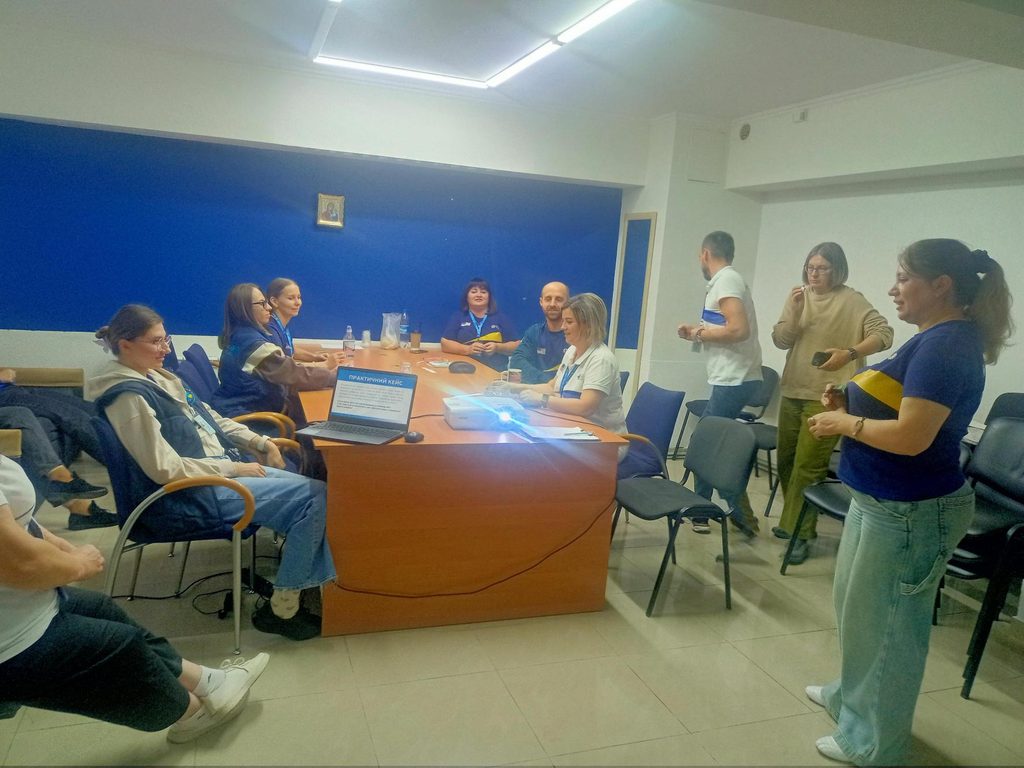
The aim is for Psychological First Aid to become a natural part of the day-to-day work of humanitarian teams, regardless of a team member’s professional role.
Those who support others need support too
“Behind every evacuation, every response following shelling and every consultation at a crisis centre are team members who encounter other people’s pain every day.”
They listen to stories of loss, witness the consequences of destruction and support people experiencing severe stress. And although their role is to help others, they too can experience fear, uncertainty and emotional exhaustion.
Iryna Maksymenko stresses that in humanitarian work — particularly in frontline areas — psychological literacy is essential both for supporting people affected by war and for protecting team members’ own wellbeing.
“Without this awareness, the work can very quickly contribute to burnout and leave the team exhausted.”
This is why Caritas is developing a network of Psychological First Aid focal points — team members from different areas of work who receive additional training and are able to support colleagues during difficult moments.
According to Iryna, those who join the initiative are people who recognise the need for this kind of support themselves. Some have a background in psychology; others don’t. What they share is their experience of working in humanitarian teams and an understanding of how important it is to know what to do when someone nearby is struggling.
The network currently includes 22 team members across five Caritas crisis centres: Kamianske, Kryvyi Rih, Mykolaiv, Poltava and Kharkiv. Six are psychologists, while the others come from different professional backgrounds.
Sometimes PFA is not enough, and more comprehensive psychosocial support is needed. Individual work with a psychologist may involve between five and 15 sessions, depending on the person’s needs. During these consultations, psychologists help people address symptoms of stress and anxiety, learn stabilisation and grounding techniques, and undertake therapeutic work.
Group sessions focus on developing self-regulation skills and coping with emotional exhaustion. If a psychologist identifies a more complex case, the person is informed about options for accessing specialised support.
Between February and July 2026, psychological services provided through the crisis centres reached:
498 people through group activities;
445 people through individual psychological support.
Oksana Mykoliuk recalls the case of a Caritas team member who, after a difficult conversation with a friend, turned to a colleague who serves as a PFA focal point. Her colleague listened and supported her. According to Oksana, after just a short conversation, the woman felt as though a weight had been lifted from her shoulders.
“We want to build a culture in which people feel able to turn to someone who can offer immediate, focused support when they are really struggling — when something feels heavy or they simply don’t feel right. A person can come and talk, even if it is only for three to five minutes,” Oksana explains.
To make such conversations possible, Caritas is creating dedicated spaces where the team can decompress and access psychological support, as well as organising peer-support meetings.
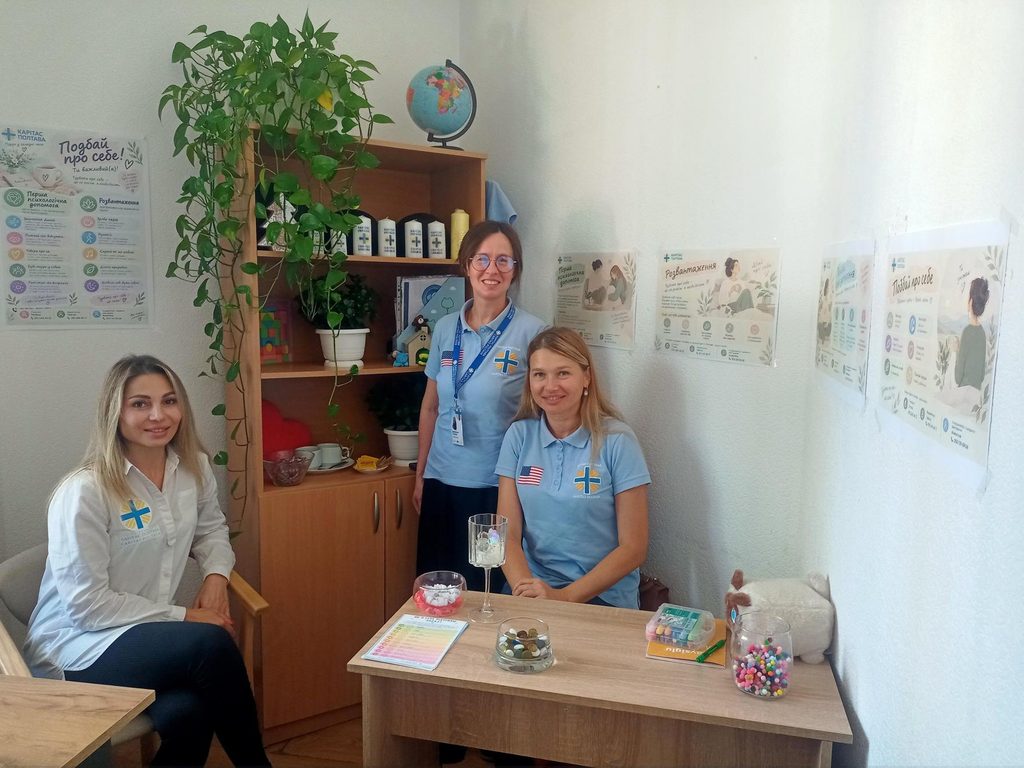
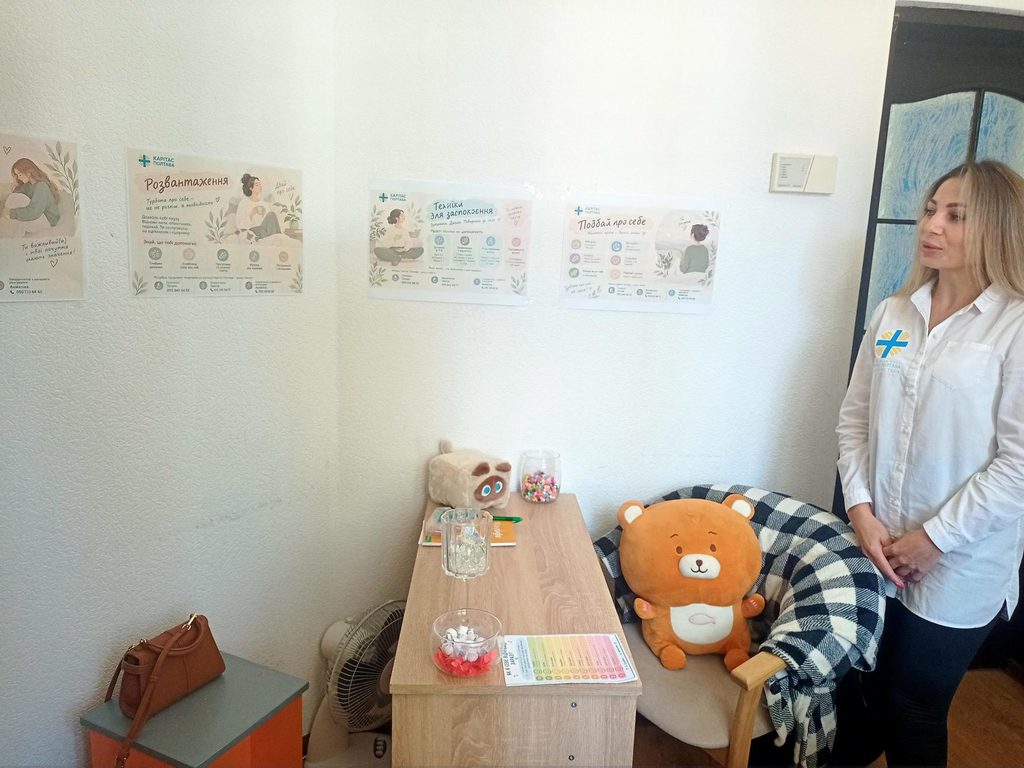
Psychological decompression space at Caritas Poltava.
In addition to general PFA training, focal points receive further preparation through online and in-person training, practical exercises and supervision sessions. During these sessions, they work through difficult situations with experts, discuss ways of providing support and receive professional guidance themselves.
Internal team support also has another important purpose: helping the team understand the limits of their own responsibility.
Iryna Maksymenko explains that humanitarian workers need to recognise when they can support someone themselves and when another professional should be involved. Constantly trying to solve every problem for other people can ultimately lead to their own exhaustion.
“A person who understands the principles of psychological stabilisation knows that they must first take care of themselves,” Iryna stresses.
Supporting others also means recognising when you need support yourself — so that you have the strength to continue helping.
For support, contact the Caritas hotline: 0800 406 506.
Tags
More news
Speech Therapy, Horseback Riding and the Latest Summer Trends: A Look at Caritas Inclusive Camps
A summer camp is a familiar part of childhood and youth: making new friends, spending a few days away from home, and coming back with dozens of photos and stories to tell.
Practical solidarity: Caritas partners meet for Country Forum
On September 23, 2026, representatives of “Caritas Ukraine,” “Caritas-Spes Ukraine,” and their partners held a Country Forum.
When every minute counts, but rushing can put lives at risk
How Caritas Rapid Response teams organise assistance in the aftermath of attacks.